

Can You Vote In California Primary If Registered As Independant
By Ben Christopher | CalMatters
If you're confused well-nigh how to vote in California'due south presidential primary, you're in expert company with Susan Sarandon.
At the beginning of January, the "Thelma and Louise" extra and Sanders enthusiast issued a public service proclamation on Twitter: "California voters: make sure to switch from independent to democrat (sic) in social club to vote for �?�@BernieSanders."
Just 1 problem: She's wrong. Political independents (known in California election parlance as "no party preference" voters) do not demand to switch parties to vote in the Democratic presidential main -- the just need to request a Democratic ballot first.
Technically, Sarandon was retweeting the account @TimOnTheTractor -- merely Tim (presumably) doesn't have an Academy Honor. He also doesn't accept 653,000 Twitter followers to misinform.
To be off-white, the minutiae of California election law is really confusing! And Sarandon is hardly lonely. Election day in California is March 3, simply already social media has become a bipartisan chorus of wrongness most the what, how and why of the state's presidential master.
If y'all're unsure virtually how to get the ballot you want, why things here are so complicated or what presidential primaries are all virtually, here are iv things to know before yous vote:
THE PRESIDENTIAL PRIMARY Volition NOT USE THE FAMILIAR "TOP TWO" BALLOT
California voters can exist forgiven for assuming that political party registration doesn't actually matter.
In 2010 voters backed a measure to create the state's nonpartisan "height ii" election system, in which all chief voters fill out a election with every candidate on it -- regardless of either the voter'southward or the candidate's political party. The tiptop two winners then motion on to the general ballot ballot -- even if they're both from the aforementioned party.
In races for country legislative and congressional seats, the top two method will still reign on the 2020 ballot.
Merely when you vote in the presidential primary, information technology's back to the one-time partisan organisation: Democrats on the Democratic ballot, Republicans on the Republican ballot, and and so on.
So while voting in California usually goes similar this nether the top ii:

(Courtesy of CalMatters)
In the presidential primary, it looks a footling more like this:
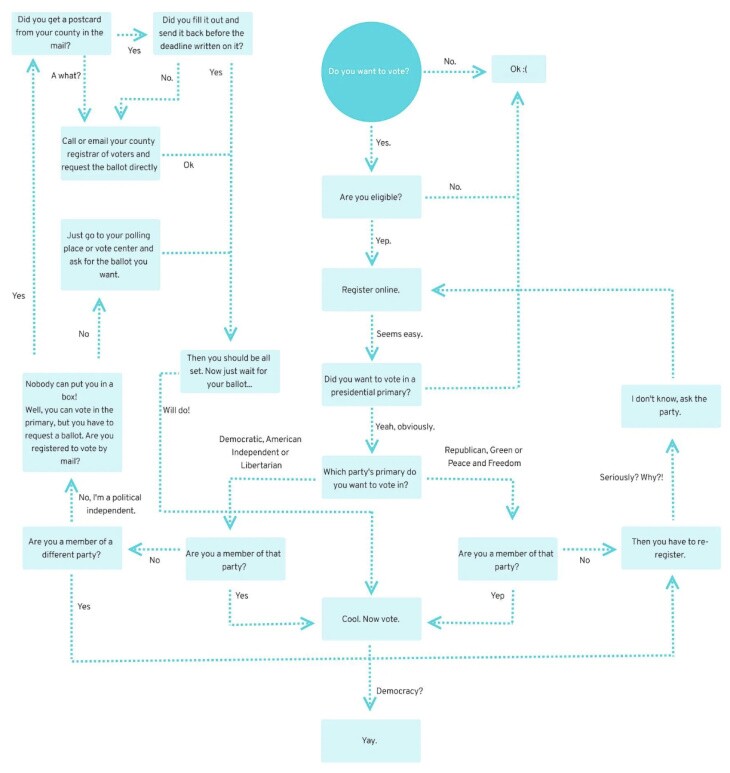
(Courtesy of CalMatters)
NO Party PREFERENCE VOTERS: PAY ATTENTION!
Registered Democrats, Republicans, Greens, Libertarians and other party members, rest assured. Y'all are guaranteed a primary ballot with all of your party's presidential contenders on information technology.
But voters who don't belong to a political party -- the fastest growing voting cake in the state -- will have to navigate a more daunting set of obstacles to bandage a presidential primary vote.
Some parties have "members only" policies:
- The Republican Political party
- The Dark-green Party
- The Peace and Freedom Party
If y'all want to vote in one of these three primaries, you'll have to join that party. You lot can't do it as a fellow member of any other party, or fifty-fifty as a "no party preference" contained. No exceptions.
The following three parties do allow political independents to bandage ballots in their presidential primaries:
- The Autonomous Party
- The Libertarian Party
- The American Contained Political party (which is the political party's proper name and not to be dislocated with existence a party-less political independent)
Only -- and this is an important caveat -- these voters practice have to specifically request the election they want.
For those who vote in person, this is a cinch. But go into your polling identify when it's time to vote and inquire. Just independents who vote by mail demand to permit your canton know which election they want ahead of time.
Maybe yous received a postcard that looks like this:
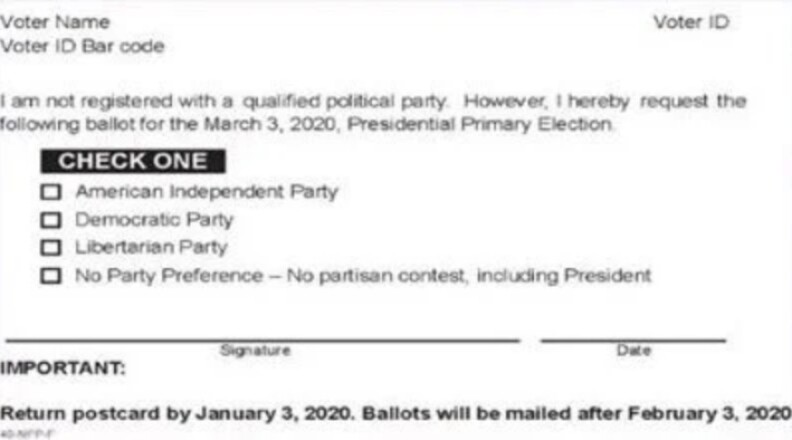
(Courtesy of CalMatters)
If so, and you filled it out and mailed it back, you should be all set. If you missed the borderline or lost the card, and you're not going to vote in person, email or call your county registrar'south office and let them know which ballot you want.
50.A. County voters:
Dean Logan, Registrar - Recorder/County Clerk
- 12400 Imperial Hwy., Norwalk, CA 90650
- Mailing Address: P.O. Box 1024, Norwalk, CA 90651-1024
- Phone: (800) 815-2666
- Hours: 8:00 a.1000. - v:00 p.m.
- Email: voterinfo@rrcc.lacounty.gov
- Website
Orange County voters:
Neal Kelley, Registrar of Voters
- 1300 South 1000 Avenue, Bldg. C Santa Ana, CA 92705
- Mailing Address: P.O. Box 11298 Santa Ana, CA 92711
- Telephone (714) 567-7600
- Hours: 8:00 a.m. - 5:00 p.thousand
- Email: ocvoter@ocgov.com
- Website
Riverside County voters:
Rebecca Spencer, Registrar of Voters
- 2724 Gateway Bulldoze Riverside, CA 92507-0918
- Phone: (951) 486-7200
- Hours: 8:00 a.m. - 5:00 p.1000.
- Email: rovweb@co.riverside.ca.usa
- Website
San Bernardino County voters:
Bob Page, Registrar of Voters
- 777 Eastward. Rialto Avenue San Bernardino, CA 92415-0770
- Phone: (909) 387-8300
- Hours: 8:00 a.m. - v:00 p.chiliad.
- E-mail: rovwebmail@rov.sbcounty.gov
- Website
Ventura County voters:
Mark A. Lunn, County Clerk-Recorder-Registrar of Voters
- 800 S. Victoria Avenue Hall of Administration, Lower Plaza Ventura, CA 93009-1200
- Phone: (805) 654-2664
- Hours: viii:00 a.thou. - v:00 p.m.
- Website
If you live in another county, you lot can find the contact information here.
And if you've already received a ballot in the post and were disappointed past the lack of presidential candidates, do not fill information technology out. You can always request a new ballot, just trying to vote twice is frowned upon (and also punishable equally "voter fraud") .
The California Secretary of Land's role has an all-in-one website where you lot can bank check your registration status, register or change your political party amalgamation online, and learn more about the presidential chief.
You can brand registration changes online through Feb xviii. Later on that, you'll have to do information technology in person -- which you can practice up to and fifty-fifty on Ballot Day itself.
(Side annotation: Anyone registered nether the "American Independent Party" is considered to be a member of that party, not an independent voter. "No political party preference" is the designation for voters who exercise not affiliate with a party. Yes, information technology's very disruptive. Desire to know more? Our friends at the Fifty.A. Times took a hard wait at this a few years agone>>)
L.A. AND Orangish COUNTIES ARE AMONG 15 DOING THINGS A Fiddling DIFFERENTLY
If you live in 1 of the counties highlighted below, voting might expect a piffling unlike this year.
In 2016, California passed the "Voter Selection Human action," a law aimed at modernizing the land's election system, such that:
- Every registered voter gets a ballot in the mail
- Voters are no longer required to go to a specific polling place, but can vote at any number of voting centers or drop-off points
- Voters can cast their ballots in person offset 11 days before, and up to and including, Election Solar day
In 2018, v counties (Madera, Napa, Nevada, Sacramento, and San Mateo) rolled out the new organisation. This year, ten more volition join their ranks, including 50.A. and Orange counties. That's fifteen counties in all containing 49% of the state population.
This is key for "no party preference" voters living in these counties who may non become the election they want in the mail. Run into the previous section for details.
Want more information on the changes? Our political reporter Libby Denkmann has more well-nigh changes to how we vote and the races to watch in Southern California >>
DELEGATE MATH Tin BE COMPLICATED
In state legislative races, the electoral calculations are straightforward: The 2 candidates who earned the most votes, regardless of party, move on to the final voting round in Nov.
But the math is trickier in the presidential primary: citizen votes are used to select party convention delegates, who so select the party'southward nominee for the White House.
Let's focus on the Democratic competition, which is leap to exist the nigh interesting one. Nationwide at that place will be four,532 Democratic delegates, 495 come from California.
In the Gilded State, presidential hopefuls can earn delegates three ways:
- Past winning a large share of the statewide vote.
- By winning a large share of the vote in any one of the land'south 53 congressional districts.
- By successfully schmoozing party leaders.
The 144 statewide delegates are awarded in proportion to a candidate'due south operation beyond the state -- up to a point. To take a contempo polling boilerplate average from FiveThirtyEight as a hypothetical ballot result, if Joe Biden wins 23% of the California vote, he would win the support of at least 23% of those statewide delegates.
Why "at least"? Party rules require candidates to demonstrate a baseline level of electoral viability: they merely earn delegates if they win at least 15% of the vote.
Just 3 candidates exceed that threshold in the polls: Biden with 23%, Sen. Bernie Sanders with 22% and Sen. Elizabeth Warren with 17%. By that math, Biden would get 36% of the delegates considering he earned 36% of the primary vote split up but among the candidates who exceeded the benchmark.
Some other 272 delegates are awarded past congressional district. That gives candidates who have strong support in a particular region of the country an opportunity to earn delegates even if they don't perform well overall.
But not all districts are created equal. The Democratic Party assigns between 4 and 7 delegates to each district depending on the number of Autonomous voters who live and vote there. Thus, San Francisco gets seven, while the state's rural, conservative northeastern commune gets 4.
For these delegates, the proportional logic is the same merely at a smaller calibration: delegates are divvied upward among candidates who earn more fifteen% of the vote in each commune.
The last 79 delegates are composed of the party elite -- people like Gov. Gavin Newsom, the land'southward sitting members of Congress, the top members of the state party. They automatically become a spot at the convention. They're also "superdelegates," meaning they can vote for whomever they desire.
Just superdelegates don't have equally much power equally they used to, thanks to a post-2016 change in the political party rules designed to wrest some control from the political party establishment. When regular delegates first vote for the nominee at their convention in Milwaukee next July, super-delegates will have to sit out the vote. It'south only if a candidate doesn't win a bulk of delegate votes outright in the first circular do the superdelegates and then get to weigh in.
The last time that happened: 1952.
This story was originally published on CalMatters website on Jan. 10.

Can You Vote In California Primary If Registered As Independant,
Source: https://laist.com/news/how-to-vote-presidential-primary-california
Posted by: behanworturearown.blogspot.com
0 Response to "Can You Vote In California Primary If Registered As Independant"
Post a Comment