

What Is The Probability That A Registered Voter Voted In Virginia Chosen At Random Vote In The 2012
What is compulsory voting?
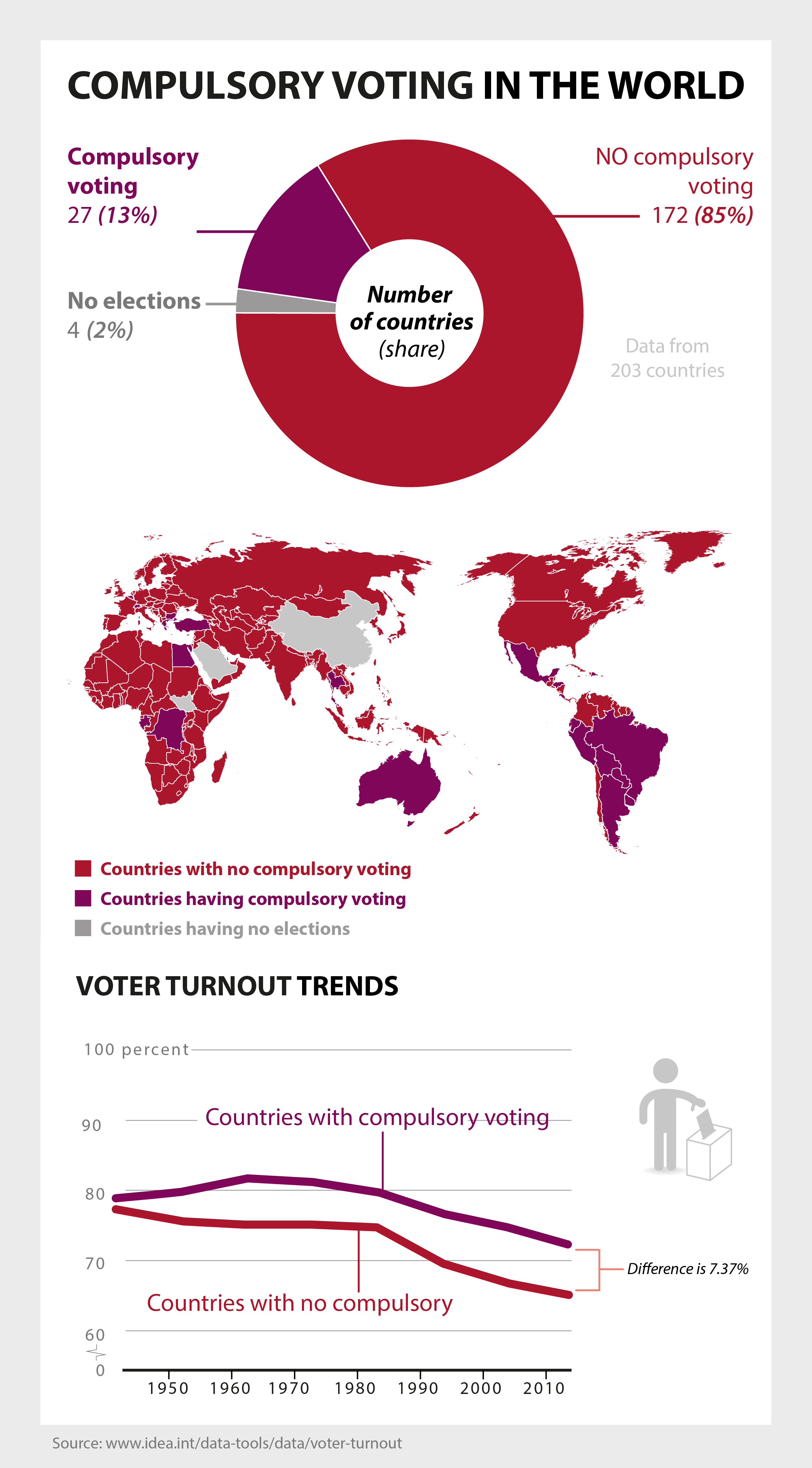 Well-nigh autonomous governments consider participating in national elections a correct of citizenship. Some consider that participation at elections is also a citizen'due south civic responsibility. In some countries, where voting is considered a duty, voting at elections has been made compulsory and has been regulated in the national constitutions and electoral laws. Some countries get as far as to impose sanctions on non-voters.
Compulsory voting is not a new concept. Some of the first countries that introduced mandatory voting laws were Belgium in 1892, Argentina in 1914 and Australia in 1924. There are also examples of countries such every bit Venezuela and the Netherlands which at one fourth dimension in their history practiced compulsory voting only have since abolished it.
Advocates of compulsory voting fence that decisions made by democratically elected governments are more legitimate when higher proportions of the population participate. They argue further that voting, voluntarily or otherwise, has an educational effect upon the citizens. Political parties can derive financial benefits from compulsory voting, since they do non have to spend resources disarming the electorate that it should in general turn out to vote. Lastly, if democracy is authorities past the people, presumably this includes all people, then it is every denizen's responsibleness to elect their representatives.
The leading argument against compulsory voting is that it is non consequent with the freedom associated with democracy. Voting is not an intrinsic obligation and the enforcement of the police would be an infringement of the citizens' liberty associated with democratic elections. It may discourage the political education of the electorate considering people forced to participate will react against the perceived source of oppression. Is a government really more than legitimate if the high voter turnout is against the will of the voters? Many countries with limited financial capacity may non exist able to justify the expenditures of maintaining and enforcing compulsory voting laws. It has been proved that forcing the population to vote results in an increased number of invalid and bare votes compared to countries that have no compulsory voting laws.
Another consequence of mandatory voting is the possible loftier number of "random votes". Voters who are voting against their free will may check off a candidate at random, particularly the top candidate on the election. The voter does not care whom they vote for every bit long as the government is satisfied that they fulfilled their civic duty. What effect does this immeasurable category of random votes accept on the legitimacy of the democratically elected government?
A effigy depicting the exact number of countries that exercise compulsory voting is quite arbitrary. The unproblematic presence or absence of mandatory voting laws in a constitution is far too simplistic. It is more constructive to analyse compulsory voting as a spectrum ranging from a symbolic, but basically impotent, law to a government which systematic follow-upwardly of each non-voting denizen and implement sanctions against them.
This spectrum implies that some countries formally have compulsory voting laws but do not, and have no intention to, enforce them. In that location are a diverseness of possible reasons for this.
Not all laws are created to be enforced. Some laws are created to merely state the government's position regarding what the citizen's responsibleness should be. Mandatory voting laws that do not include sanctions may autumn into this category. Although a authorities may not enforce mandatory voting laws or even accept formal sanctions in law for failing to vote, the constabulary may have some effect upon the citizens. For example, in Austria voting is compulsory in only two regions, with sanctions being weakly enforced. However, these regions tend to have a higher turnout average than the national average.
Other possible reasons for not enforcing the laws could be complexity and resources required for enforcement. Countries with limited budgets may not place the enforcement of mandatory voting laws as a high priority withal they hope that the presence of the constabulary will encourage the citizens to participate.
Tin a country exist considered to practice compulsory voting if the mandatory voting laws are ignored and irrelevant to the voting habits of the electorate? Is a country practicing compulsory voting if at that place are no penalties for not voting? What if there are penalties for failing to vote but they are never or are scarcely enforced? Or if the penalisation is negligible?
Many countries offer loopholes, intentionally and otherwise, which allow non-voters to get unpunished. For example, in many countries it is required to vote merely if you are a registered voter, but information technology is not compulsory to register. People might then have incentives not to annals. In many cases, like Commonwealth of australia, an acceptable excuse for absenteeism on Election Mean solar day will avert sanctions.
The diverse forms compulsory voting has taken in different countries refocuses the perception of it away from an either present or absent practice of countries to a study of the degree and manner in which the authorities forces its citizens to participate.
Which countries practice compulsory voting?
Laws, Sanctions & Enforcement
Below is a table containing all the countries that have a constabulary that provides for compulsory voting. The first column lists the proper noun of the land, the second column the type of sanctions that the relevant state imposes confronting non-voters and the third column contains the information on to what extent the compulsory voting laws are enforced in do.
| Country | Type of Sanction(*) | Enforced | Year Introduced | Comments |
|---|---|---|---|---|
| Argentina | 1, 2, iv | Yes | 1912 | Voluntary for those between sixteen and eighteen years of age. |
| Australia | 1, 2 | Yes | 1924 | - |
| Austria (Tyrol) | 1, ii | Yes | Practiced from 1929 to 2004 | The region of Tyrol. |
| Austria (Vorarlberg) | ii, 3 | Yes | Good from 1929 to 1992 | The region of Vorarlberg. |
| Austria (Styria) | N/A | Yes | Expert from 1929 to 1992 | The region of Styria. |
| Belgium | ane, ii, 4, 5 | Aye | 1892 (men); | Women in 1949. |
| Bolivia | 1, 2, four | Aye | 1952 | Non enforced for those who are over 70 years old, who testify they have been absent from the national territory at the fourth dimension of voting by a moment of voting, and those who could not vote past strength majeure. |
| Brazil | 1, ii, 4, 5 | Aye | 1932 | Voluntary for the illiterate, those over 16 and nether 18 years of historic period, and those over seventy years of historic period. |
| Bulgaria | None | No | 2016 | - |
| Chile | 1, 2, three | Aye | Adept from 1925 to 2012 | Chile abased compulsory voting in 2012. |
| Congo, Democratic Commonwealth of the | Due north/A | N/A | N/A | |
| Costa Rica | None | No | 1959 | Although the electoral legislation formally provides for the obligation of suffrage, it is mostly understood equally a borough duty, without legal sanctions for non-compliance. |
| Republic of cyprus | ane, 2 | Yes | Practiced from 1960 to 2017 | Cyprus abandoned compulsory voting in 2017. |
| Dominican Democracy | None | No | Practiced till 2010 | Dominican Republic formally abased compulsory voting in 2010. |
| Republic of ecuador | ane, 2 | Yes | 1947 for men, 1968 for both sexes | Voluntary for those between 16 and 18years of age, those over 65 years of age, Ecuadorians who are members of the Armed Forces and National Police, those with disabilities and those who live abroad. |
| Egypt | i, two | No | 1956 | This is the yr from which we have found the earliest police force. |
| Fiji | i, two, 3 | Yes | Practiced from 1992 to 2006 | Fiji abandoned compulsory voting in 2014. |
| France (Senate only) | two | No | 1950's or 60'south | - |
| Gabon | N/A | No | N/A | - |
| Hellenic republic | iii | No | 1926 | Administrative sanctions, including prohibition to result a passport, a driving license or an occupational license, were officially lifted in year 2000. Voting is non compulsory for those who are over lxx years old, hospitalized citizens, and those residing away. |
| Guatemala | None | No | N/A | Guatemala abandoned compulsory voting in 1990. |
| Honduras | None | No | N/A | - |
| Italy | 5 | No | Practised from 1945 to 1993 | - |
| Lebanon | N/A | N/A | Due north/A | 21 years of age; compulsory for all males; authorized for women at age 21 with elementary education; excludes military personnel. |
| Liechtenstein | 1, two | Yes | Due north/A | - |
| Luxembourg | 1, 2 | Yep | North/A | Voluntary for those over 70. |
| Mexico | None | No | 1857 | - |
| Nauru | 1, 2 | Aye | 1965 | - |
| Netherlands | - | No | Practised from 1917 to 1967 | - |
| Panama | None | No | North/A | - |
| Paraguay | 2 | No | Northward/A | Voluntary for those over 75 years of age. |
| Republic of peru | 1, 2, 4 | Yes | 1933 | Voluntary for those over 75 years of age. |
| Philippines | None | No | Endeavour to practice 1972-1986 nether martial law. | - |
| Samoa | two | Yes | 2019 | First implemented in 2021 General Elections |
| Spain | N/A | No | Skillful from 1907 to 1923 | |
| Singapore | 2, 4 | Yes | N/A | The non-voter is removed from the voter register until he/she reapplies and provides a reason. Fee applies only if the voter does not have valid reason for non voting. The non-voter is also disqualified from existence a candidate at any subsequent Presidential or Parliamentary election. |
| Switzerland (Schaffhausen) | 2 | Yes | 1904 | Practised in only one canton. Abolished in other cantons in 1974. |
| Thailand | None | No | 1997 | - |
| Turkey | ane, ii | Yes | North/A | - |
| Uruguay | 1, 2, 4 | Aye | 1934 | Compulsory voting was not in practiced until 1970. |
| U.s.A (some states) | Encounter comments | No | Georgia and Virginia had legal provisions for imposing fines for not voting in the 18th century; Northward Dakota (1898) and Massachusetts (1918) amended their constitutions to let for compulsory voting, simply these states never enacted statutes to implement it (Source: The Instance for Compulsory Voting in the U.s.. Harvard Law Review 121, no. 2 (2007): 591-612. Accessed Apr 21, 2021). Information technology appears that the state of Massachusetts all the same has a provision in the Constitution allowing the general court the potency to provide for compulsory voting. (Source: Constitution of Massachusetts) | |
| Venezuela | 4 | No | Practiced from 1958 to 1993 | Venezuela abandoned compulsory voting in 1993. A provision in the Constitution describing voting equally a duty remained until 1999. All the same, the elimination of legal sanctions in 1993 marks that year every bit the stop of compulsory voting (Carey and Horiuchi, 2017). Compulsory voting was enforced until 1973. |
(*) The numbers listed in the column for Blazon of Sanction stands for dissimilar types of sanctions. These are as follows:
1. Explanation. The non-voter has to provide a legitimate reason for his/her abstention to avert further sanctions, if whatsoever exist.
2. Fine. The non-voter faces a fine sanction. The amount varies among the countries, for instance AU$xx-$AU50 in Australia, from $50 to $500 pesos in Argentina.
iii. Possible imprisonment. The non-voter may face imprisonment as a sanction, however, we exercise not know of any documented cases. This can also happen in countries such every bit Commonwealth of australia where a fine sanction is common. In cases where the not-voter does non pay the fine later on being reminded or after refusing several times, the courts may impose a prison house sentence. This is commonly classified as imprisonment for failure to pay the fine, non imprisonment for failure to vote.
four. Infringements of civil rights or disenfranchisement. Information technology is, for example, possible that the non-voter, afterward not voting in at least four elections inside 15 years will exist disenfranchised in Belgium. In Peru the voter has to bear a stamped voting carte for a number of months afterward the ballot as proof of having voted. This stamp is required in social club to obtain some services and goods from some public offices. In Singapore the voter is removed from the voter register until he/she reapplies to exist included and submits a legitimate reason for not having voted. In Republic of bolivia the voter is given a card when he/she has voted so that he/she can proof the participation. The voter would non be able to receive his/her salary from a depository financial institution if he/she cannot prove the proof of voting during three months subsequently the ballot.
5. Other. For example, in Belgium it might be difficult to get a job within the public sector if you are non-voter. There are no formal sanctions in United mexican states or Italy merely possible arbitrary or social sanctions. This is called the "innocuous sanction" in Italy, where information technology might for example be difficult to secure day care placement for your child or a similar service, but this is not formalised.

Source: https://www.idea.int/data-tools/data/voter-turnout/compulsory-voting
Posted by: behanworturearown.blogspot.com
0 Response to "What Is The Probability That A Registered Voter Voted In Virginia Chosen At Random Vote In The 2012"
Post a Comment